1 September 2026 · 7 min read
How I Actually Scaled NexElite.Media

Anyone can ship a good-looking website in a weekend. The part nobody puts in a portfolio is what happens after: turning that website into something that actually makes money, on its own, at scale. That's the part of NexElite Media I want to walk through, because it's the part almost nobody talks about.
The site was never the hard problem
I designed and built NexElite Media's entire front end myself: an editorial-print design system, GSAP and Lenis choreography, 3D tilt cards, dedicated case study routes. That work matters, but it's table stakes. A beautiful site with zero traffic is a portfolio piece, not a business. The real project started the day the site went live, not the day it shipped.
Traffic doesn't show up, you build the pipes for it
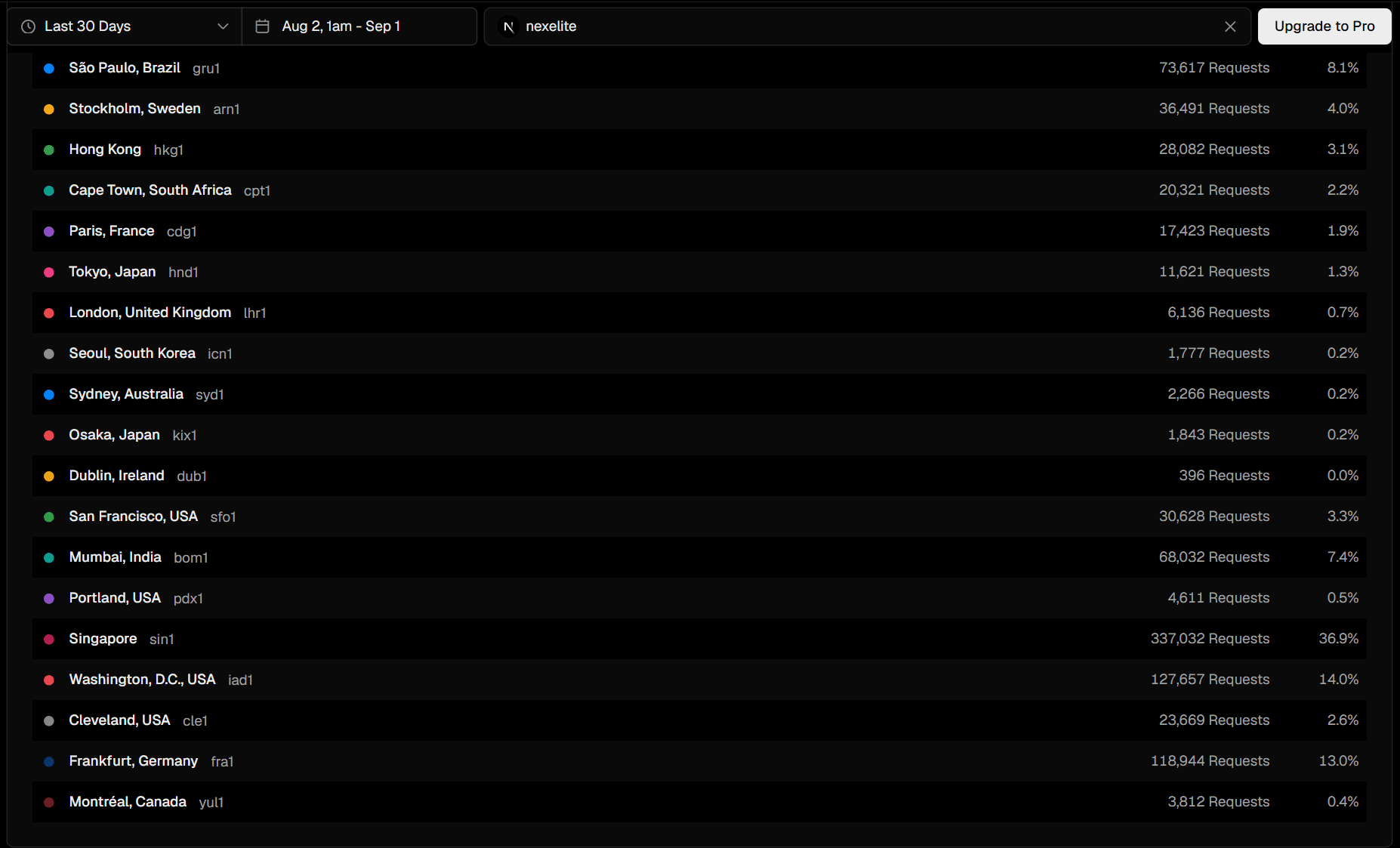
Right now the site is pulling requests from over twenty edge regions worldwide, Singapore, Washington D.C., Frankfurt, Mumbai, São Paulo, all at once, adding up to close to a million requests in a single 30-day window. That doesn't happen by publishing a page and waiting. It happens because every part of the stack, from routing to caching to how pages are structured, was built assuming global, not local, demand from day one.
Concretely: pages are statically generated and served from the edge, so a visitor in Singapore and a visitor in São Paulo both get a near-instant response instead of one of them eating a cross-continental round trip. That single decision does more for conversion than almost any copy change I've made.
SEO is a system, not a checklist
The SEO advice everyone repeats, meta tags, alt text, sitemaps, is real but it's the floor, not the strategy. What actually moved the needle was treating structured data as a first-class part of the build: proper JSON-LD on every case study and content page, clean canonical URLs, and Open Graph metadata that's generated per page instead of copy-pasted once and forgotten.
The other half is content architecture. Each client case study lives on its own dedicated route with its own metadata, its own structured data, its own reason to rank for a specific query, instead of being a section buried on a single long homepage. Search engines reward specificity. A page that's clearly about one thing outranks a page that's vaguely about five things.
What breaks when the traffic is real
Scale exposes problems that don't exist at low volume. A slow image, an unindexed query, a cache that invalidates too aggressively, none of these matter when you have ten visitors a day. At real scale they compound into lost conversions and, worse, lost trust with search engines that start deprioritizing a site that feels slow or inconsistent.
- Core Web Vitals aren't a vanity metric once you're at scale, they're directly tied to ranking and to how many visitors bounce before the page even paints.
- Edge caching has to be deliberate. Cache too little and you pay for it in latency and cost; cache too aggressively and you serve stale content to real clients and search crawlers alike.
- Analytics without alerting is a blind spot. I watch request volume by region weekly, not because the number itself is interesting, but because a sudden drop in one region is usually the first sign something upstream broke.
- Monitor for scrapers and bot traffic separately from real users. Raw request counts look impressive but a meaningful chunk of any public site's traffic isn't a human, don't let it distort what you think is working.
- Every new page is a liability until it's indexed correctly. I check Search Console after every deploy that adds routes, not after something looks wrong.
The actual lesson
Scaling NexElite Media wasn't one big decision, it was refusing to treat the site as finished the day it launched. The design system got me a good-looking site. The infrastructure and SEO decisions got me a site that shows up, loads fast, and holds up under real global demand. Both matter, but only one of them shows up in the analytics dashboard.